
Armor & Modules
By Agent Delta
Anyone familiar to tank shooter sims will already understand that tanks have different thicknesses of armor in different areas and that every area is harder to penetrate if you try to shoot it at an angle, instead of perpendicular to the plate.
Tyr preserves these familiar mechanics while also adding very specific Module parts to each tank; these can generally be thought of as weakpoints, but, as you will see, it pays to know exactly where to shoot your enemy and for what reasons.
Armor & Penetration
Every tank has a set penetration value for their respective cannon. Using Lightweight and High Explosive Shells will lower that value (-10% pen and flat 45mm pen); the only tank that can increase their pen value is Arbalest, and only when using their Siege Shot (100mm + 30% pen).
- 50mm of penetration: Ikarus, Fuse
- 60mm of penetration: Alecto, Tempest, Valor
- 70mm of penetration: Kestrel, Phantom, Seeker, Ranger, Maul
- 80mm of penetration: Rook, Deadeye, Helio, Atlas, Tricera, Fortis
- 90mm of penetration: Ark
- 100mm of penetration: Arbalest
While in Sniper Mode, you will see a colored overlay on targets which shows pen-able areas (and Modules).
- Green = shell will penetrate
- Grey = shell will be blocked
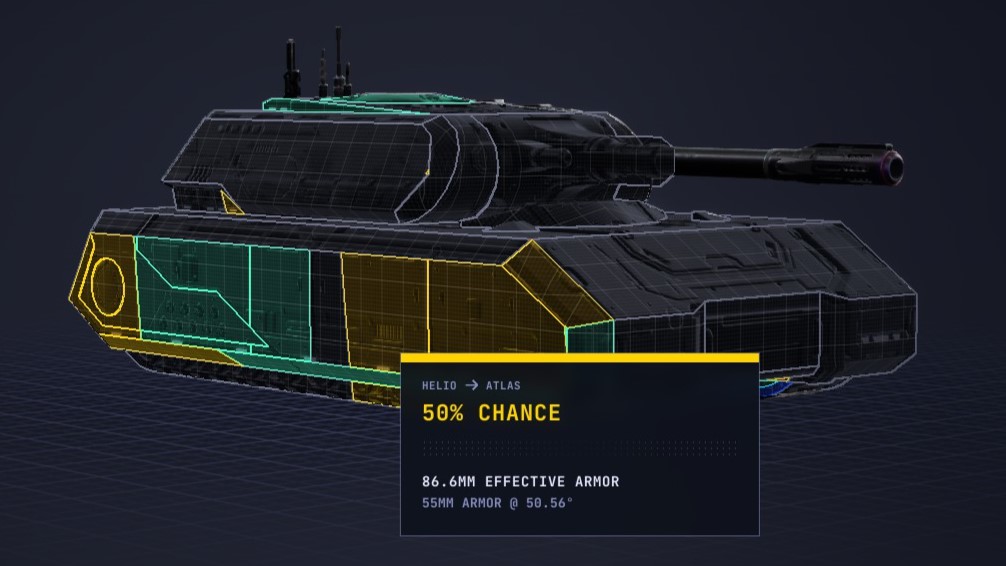
- Yellow = shell may penetrate
- Blue = shell will penetrate Module for damage and effect (see in next major section)
- Magenta = shell will disable Treads, but not deal damage (see in next major section)
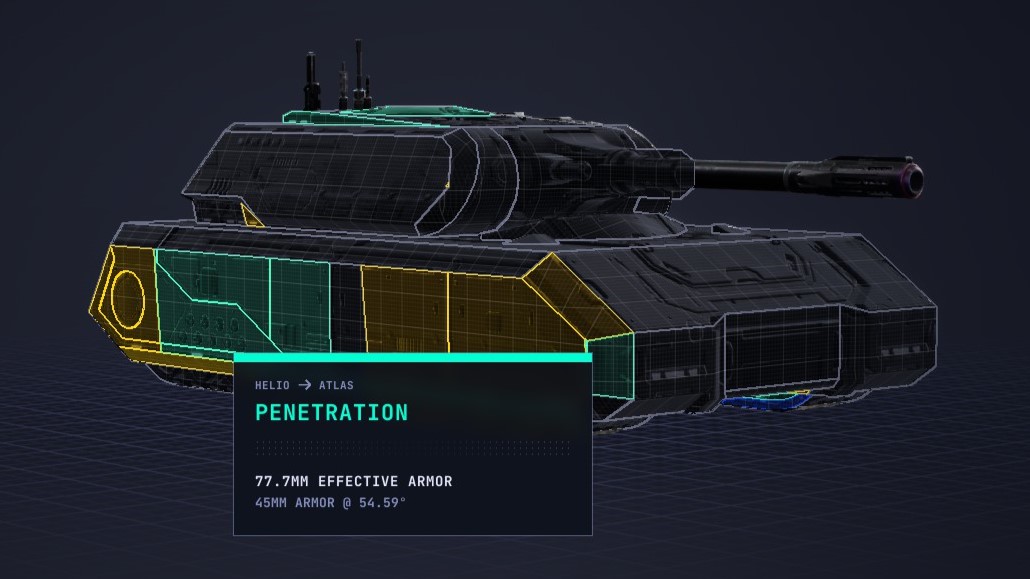
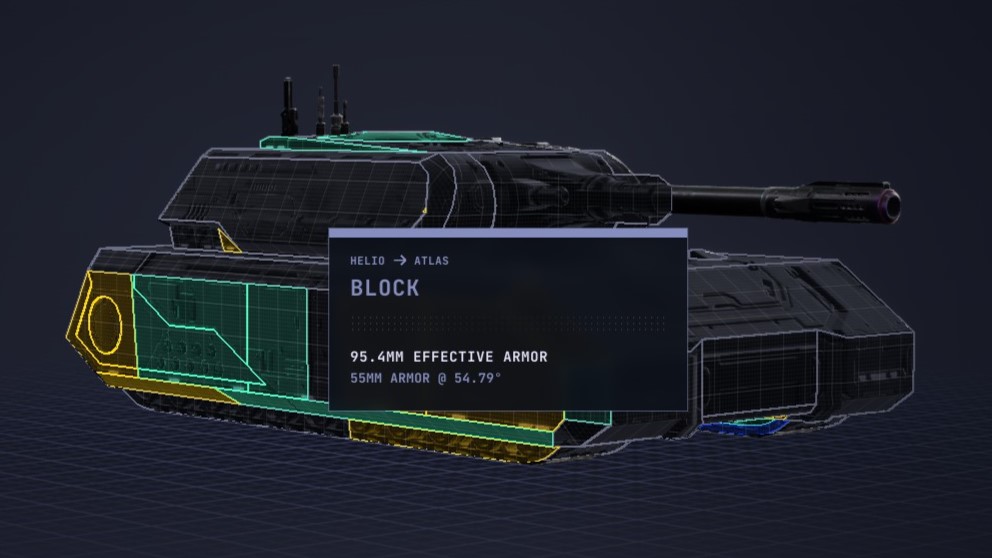
When targeting Heavy tanks or Rook, you may see yellow sections in Sniper Mode. These appear when your tank's penetration value is within 10% of meeting the penetration required for the shot. (As in the picture below, Helio will see these when aiming at armor requiring 80-88mm of penetration.) Shots made like this have a flat 50% chance of penetrating and dealing normal damage.
The dot at the center of your reticle will also change color appropriately when aiming at various parts of an enemy tank. Check this to confirm whether or not your shot will be blocked by nearby terrain!
Angling
To have the best shot at penetrating an enemy's armor, you'll want to be looking at their armor dead-on, like a flat wall facing perpendicular to you. Armor that sits at an angle relative to you is effectively stronger and may beat out your penetration value if the angle is steep enough. Below you can see how Atlas' effective armor changes drastically depending on what profile he shows to his attacker.
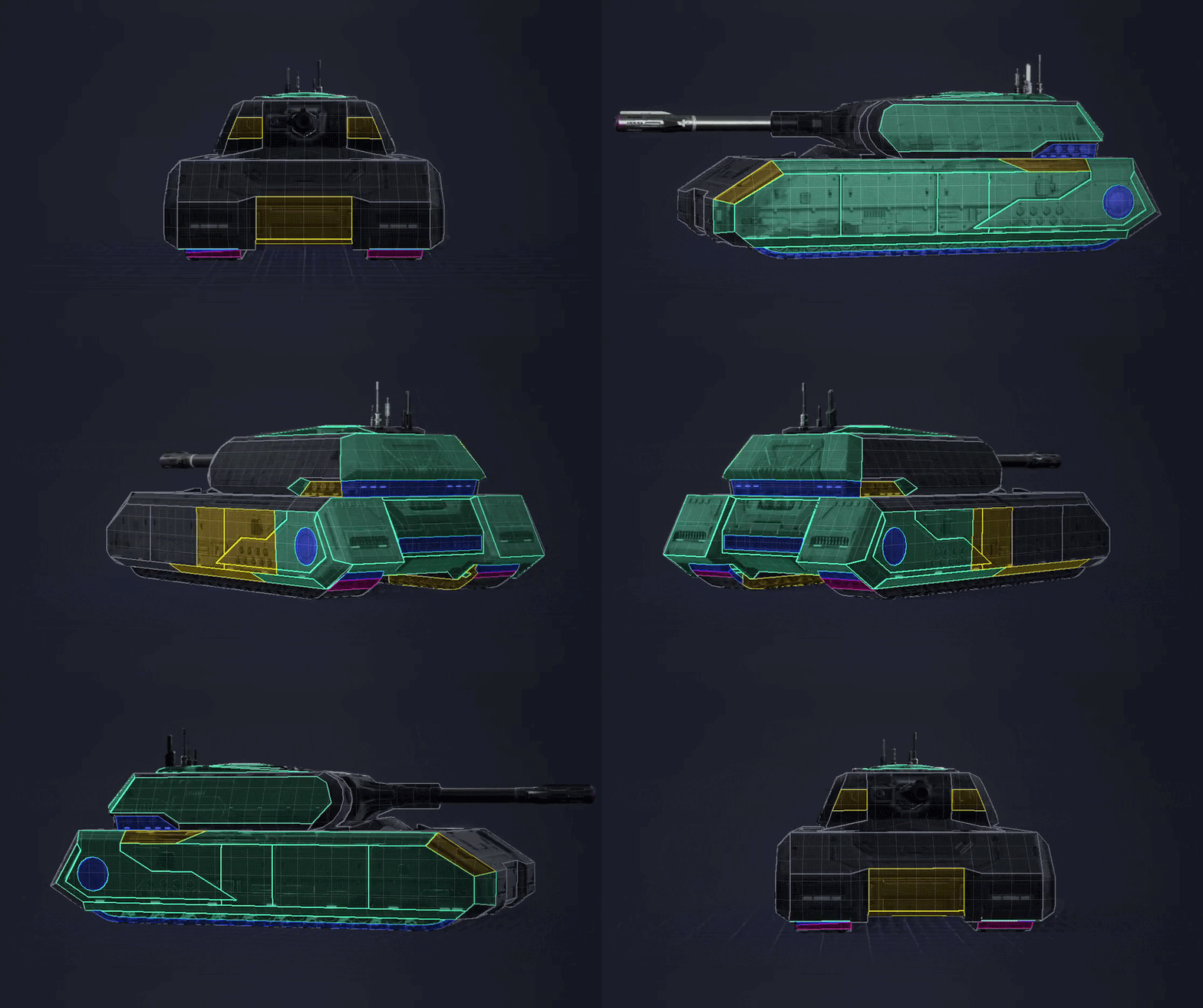
Knowing how to angle your armor is incredibly important for Heavy tanks (and some Mediums)! Inspect these tanks in the Armor viewer here on Tyr HQ or in-game to get a better sense of exactly how to approach your enemies and give yourself the best chance of blocking a shot!
Modules
Each tank also has Modules that can be shot to apply negative effects or deal increased damage. There are currently 7 types of Modules, but each tank only features 2-4 of them. Most of them can be identified easily by where they are placed on the tank, but a few are not so obvious.
Penetrating a Module deals regular damage on top of its added effect, but many tanks feature ways to increase damage when penetrating Modules or the time Modules stay broken. When a Module affecting functionality on a tank is damaged, it will be repaired over a set amount of time, but again, various tanks have ways of altering this time period. However, if the same Module is damaged over and over in a very short window, the repair time will get faster and faster, generally preventing tanks from becoming permanently immobilized by repeated fire. (This does not apply to the Critical or Fuel Tanks Modules.)
More specifically:
Each "functional" Module type has 3 hard-set default timers for how long they will stay broken.
- Ability Modules: 10 / 5 / 2.5 seconds
- Engine Modules: 8 / 4 / 2 seconds
- Turret Modules: 8 / 4 / 2 seconds
- Gun Modules: 6 / 3 / 1.5 seconds
- Track Modules: 5 / 3 / 1.5 seconds
On first break, the Module will be broken for the duration of the first (longest) timer. If the Module is shot again before 10 full seconds have passed but AFTER at least half of the current timer's duration has passed, the break timer will reset to the next timer down the list. Once the third (shortest) timer is reached, that Module will then become completely immune to breaking for 10 seconds (but can still be shot for the usual damage), after which subsequent breaks will start again at the first (longest) timer.
For example, let's say (an un-upgraded) Helio's turret Module is broken. It will be broken for 8 seconds. If it is shot again in under 4 seconds, the break timer will not reset. If it is shot again after 10 seconds have passed, it will break again for 8 seconds. If it is shot again within 4-10 seconds after breaking, the break timer will reset to 4 seconds. If it is shot again after this within 2-10 seconds, the break timer will reset to 2 seconds. As soon as this happens, the Module will become immune to breaking again for 10 seconds (but the 2-second break timer will still play out inside this time). If it's shot again after this grace period, the break timer will restart at 8 seconds.
This is all calculated separately for each Module on a tank.
Critical
Penetrations on a Critical Hit Module deal +50% damage.
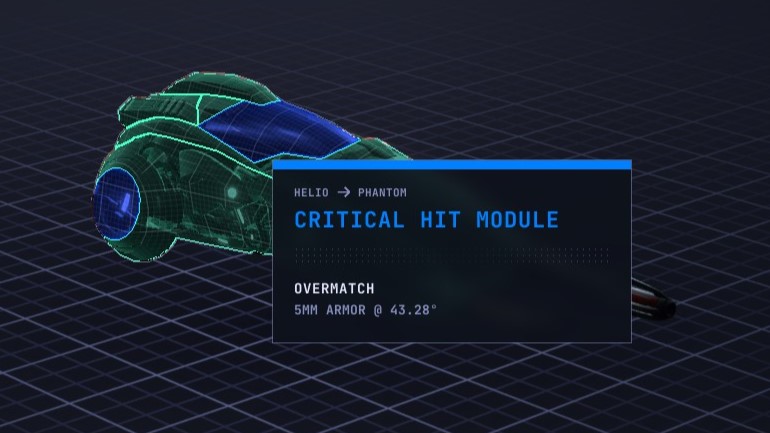
- Kestrel: circular section on the upper back of the turret
- Phantom: windshield
- Ark: small elongated section on the back of the turret
- Arbalest: rectangular section on the back of the hull
- Valor: circular sections towards the back on the sides of the hull
- Ranger: rectangular section on the back of the hull
- Helio: circular sections on the upper sides of the turret
- Atlas: elongated section along lower back of the turret
- Tricera: small circular sections on the inner sides of the hull
- Fortis: small circular sections on the inner sides of the turret
Fuel Tanks
Penetrations on a Fuel Tank Module start a fire on the enemy tank, dealing 160 damage over the next 8 seconds (20 damage per tick). This DoT cannot be reset, stacked, or triggered again until the first fire finishes its duration.
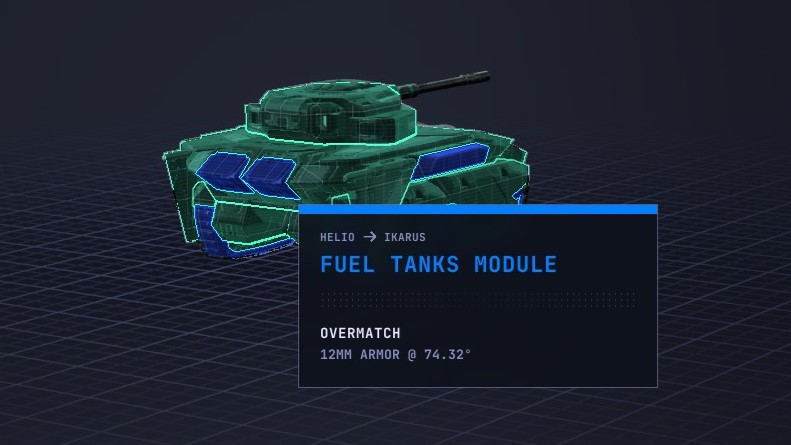
- Alecto: rectangular section on the lower back of the hull
- Kestrel: two rectangular sections on the back of the hull
- Ikarus: two rectangular sections on the back of the hull
- Tempest: circular exhaust port on the back of the hull
- Atlas: rectangular section on the back of the hull
Gun
Penetrations on a Gun Module prevent that tank from being able to fire its cannon until the Module is repaired (default 6 seconds).
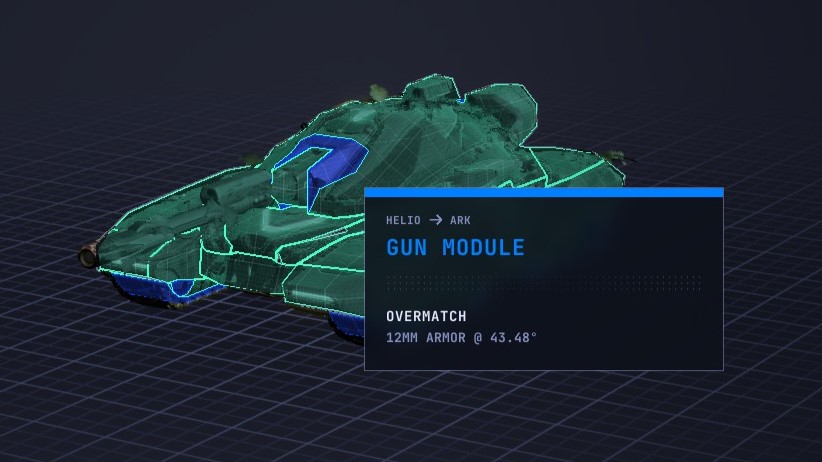
- Ark: section surrounding the barrel on the turret
- Arbalest: small circular sections on the inner sides of the turret
- Tempest: shell cylinder on the back of the turret
- Ranger: rectangular section on the back of the turret
Turret
Penetrations on a Turret Module prevent that tank from rotating their turret until the Module is repaired (default 6 seconds). (But they can still move their hull and fire their cannon!)
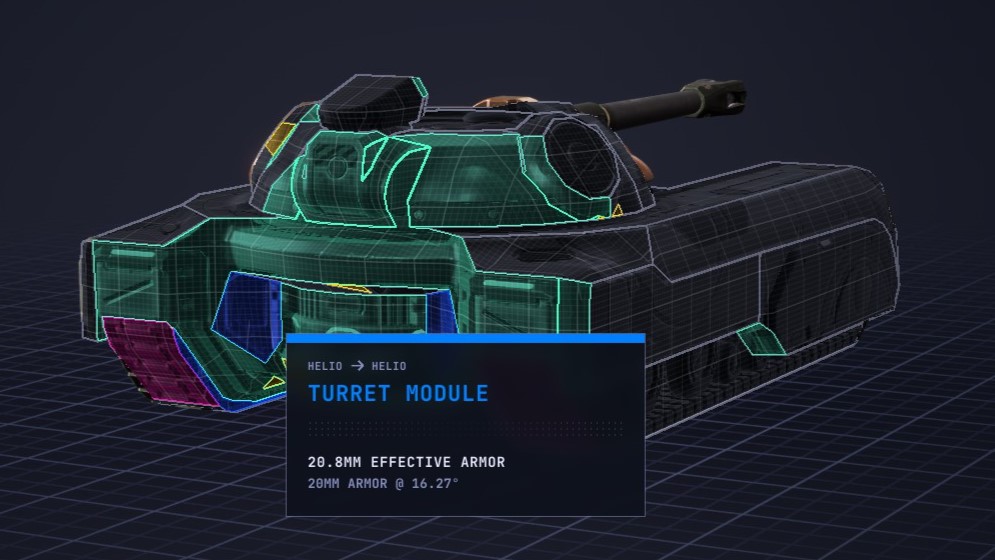
- Alecto: rectangular section on the back of the turret
- Seeker: triangular tabs on either side of the turret
- Rook: elongated section on the back of the turret
- Maul: elongated section on the back of the turret
- Helio: pentagonal sections on the inner back of the hull
- Tricera: circular section on the back of the turret
Ability
Penetrations on an Ability Module prevent that tank from activating their ability until the Module is repaired (default 10 seconds).
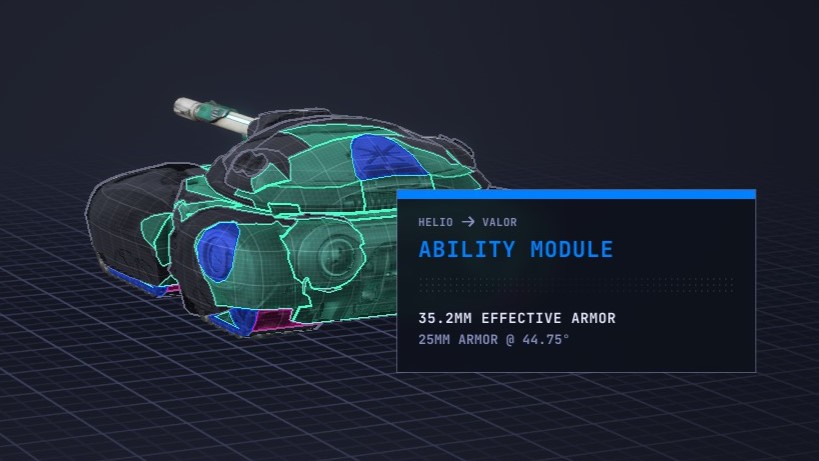
- Alecto: small circular sections on the inner sides of the hull
- Phantom: two circular sections on the sides of the hull
- Ikarus: two elongated sections on the upper sides of the hull
- Fuse: either end of the missile pod on top of the turret
- Valor: arch-shaped section on the back of the turret
- Rook: hexagonal section on the lower front of the hull
- Deadeye: rectangular section on the back of the hull
- Maul: circular exhaust port on the back of the hull
Engine
Penetrations on an Engine Module will limit that tank's speed and acceleration until the Module is repaired (default 8 seconds).
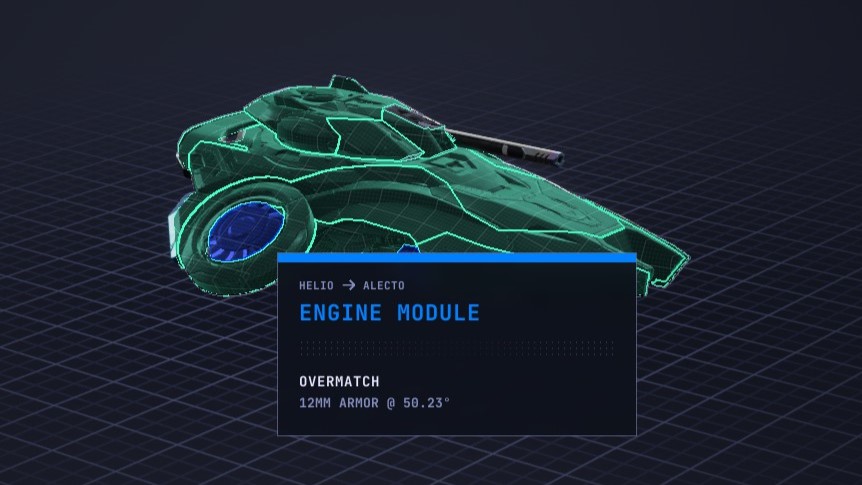
- Alecto: rotary fans on either side
- Phantom: circular exhaust port on the back of the hull
- Fuse: circular exhaust port on the back of the hull
- Seeker: rectangular section on the back of the hull
- Arbalest: trapezoidal sections on the sides of the hull
- Fortis: cylindrical section on the back of the hull
Treads
Penetrations on a Treads Module prevent that tank from moving at all until the Module is repaired (default 5 seconds).
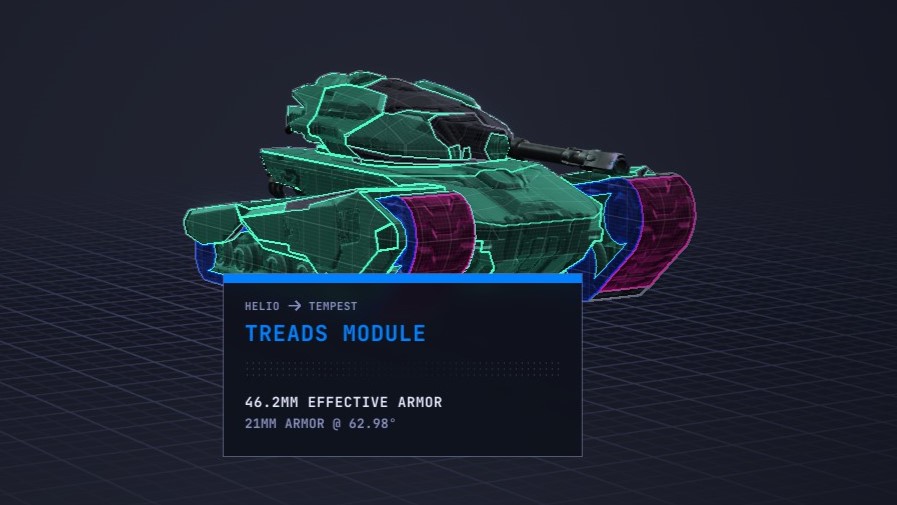
Most Medium and Heavy tanks feature magenta-colored tracks that can be shot for the same immobilizing effect, but disabling their Treads this way DOES NOT DEAL DAMAGE to the tank's health.
In more technical terms, breaking Treads this way counts as a Module break for things like Weakness Analyzer, but not as damage or penetration for things like Ark's "penetration reduction reload" tech node.
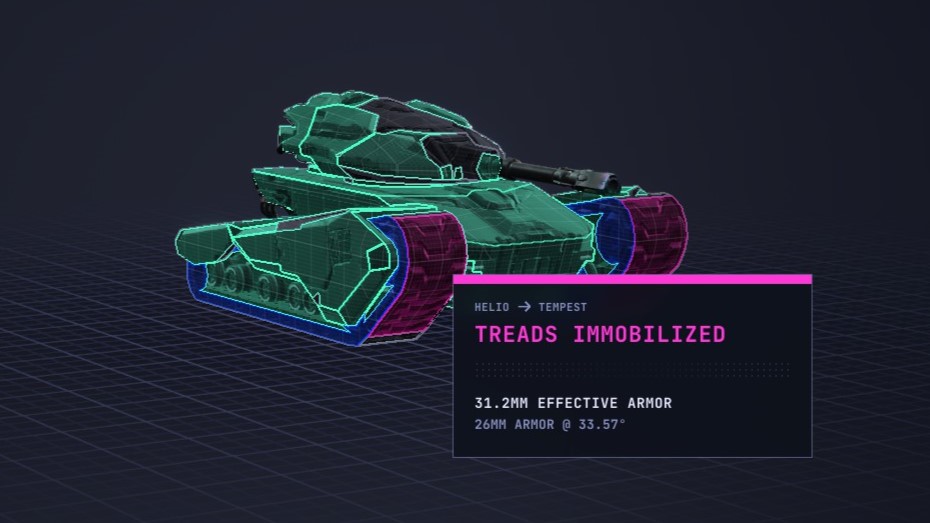
The Treads Modules on nearly all tanks are pretty obvious, but two special instances are worth mentioning:
- Valor: two taller sections in the middle of the tank on either side
- Atlas: two circular sections towards the back of the tank on either side
Overmatch
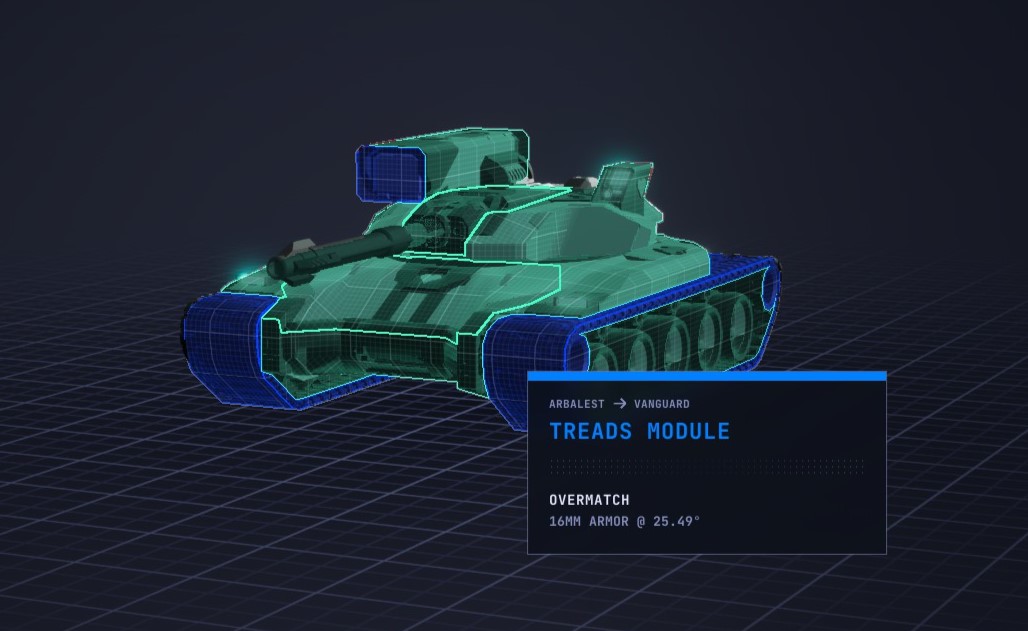
If the penetration value of a tank's shells is more than 4 times the nominal armor of any part of an enemy tank, it "Overmatches", meaning that the shot will penetrate the target regardless of the angle. More importantly, Overmatching can turn magenta-colored Track-only shots into full Module breaks that also deal damage.
Final Tips
In general, aiming for Modules is always a good idea, but it will be up to you to make the shot. Many Modules are placed such that they offer an enticing target but may lead your shot to being blocked or whiffed entirely if you're not careful. Furthermore, being familiar with your own tank's Modules (and Armor profile) will enable you to make important tactical decisions about how to approach each enemy and situation. Make the most of it!